
Planning a DNP Scholarly Project From Clinical Problem to Evaluation
A practical framework for developing a focused DNP project with measurable outcomes and realistic implementation.
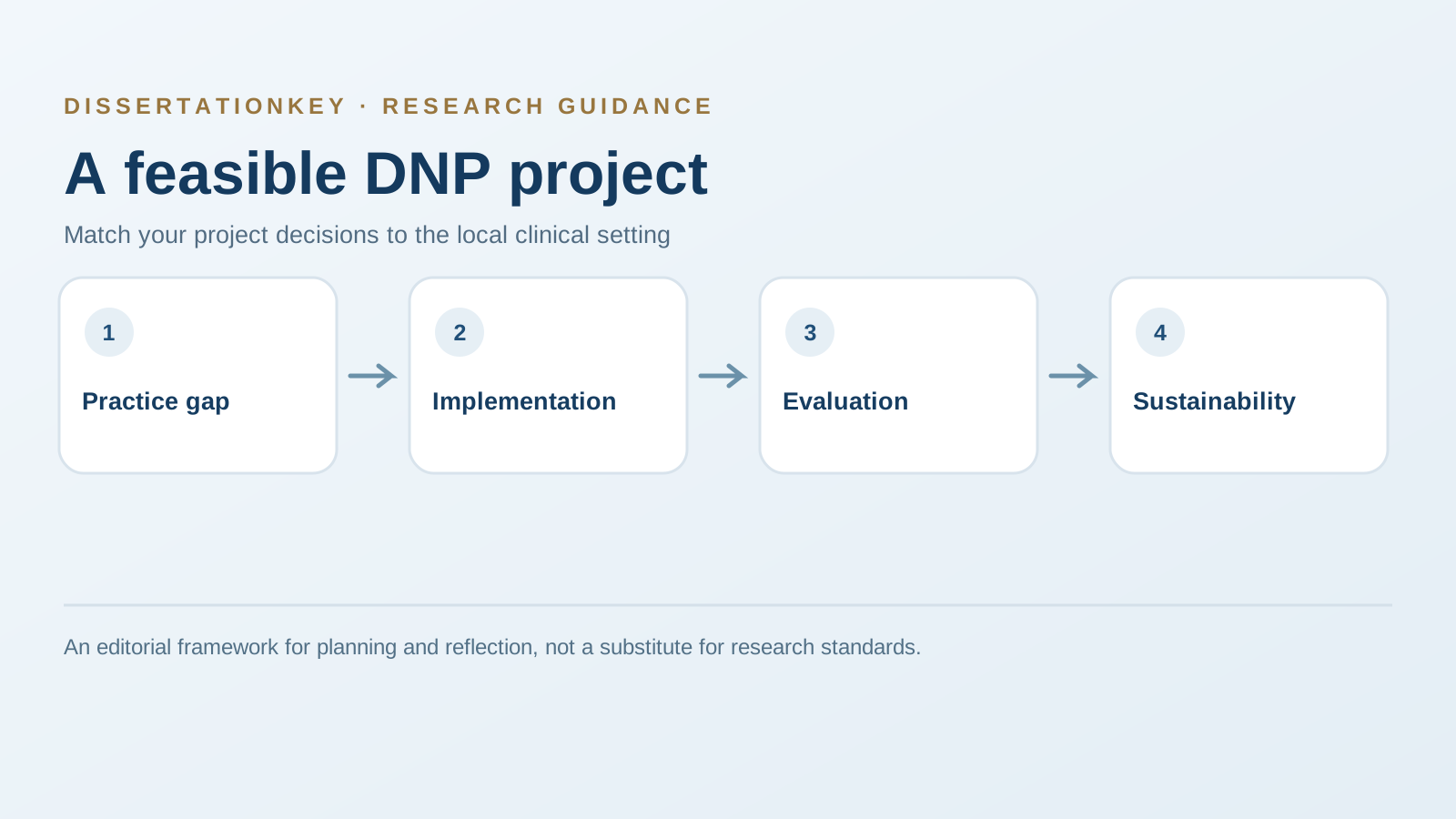
A practical framework for developing a focused DNP project with measurable outcomes and realistic implementation. The sections below explain the decisions behind the process and use hypothetical nursing examples where practical, while recognising that individual universities and clinical settings may have different requirements.
Start with a clinical problem rather than a preferred solution
A Doctor of Nursing Practice project usually begins with an issue identified in clinical practice, such as inconsistent screening, delayed follow up or variation in how a guideline is applied. It is tempting to start by choosing an intervention that appears promising, but the project will be stronger if the team first understands what is happening in the local setting. A brief needs assessment can reveal whether the problem concerns knowledge, workflow, resources or a combination of factors.
For example, a student might notice that discharge follow up calls are completed inconsistently in a particular service. Before proposing a new checklist, the student would need to examine how calls are currently assigned, whether staff have enough time and how completion is documented. This example is illustrative and does not imply that any particular intervention has been proven effective in that setting.
A DNP project usually begins with a practice concern that can be addressed within a defined clinical setting. The first challenge is distinguishing a problem that is observable from a proposed solution that has not yet been evaluated. For example, a clinic may report missed follow up appointments among patients with hypertension. Introducing reminder calls may seem sensible, but the team should first examine available attendance data and consider other explanations such as transport difficulties, appointment availability or communication barriers. A strong problem statement describes what is happening, who is affected and why the issue matters to care quality or service delivery. It should also explain what is known locally rather than relying entirely on national statistics. Local evidence helps show that the proposed project responds to a genuine practice need.
Define the population, setting and project aim
The project aim should describe a change that matters to patients, staff or the care process while remaining achievable within the programme's timeframe. A statement such as improving patient safety is too broad to guide implementation because it does not specify which aspect of safety is being addressed. A more useful aim identifies the practice gap, the setting and a measurable indicator of progress.
A process measure might be the proportion of eligible patients receiving a documented follow up call, whereas an outcome measure could concern patient understanding or an appropriate clinical endpoint. These measures answer different questions and should not be treated as interchangeable. The choice depends on the intervention, available data and whether the project has enough time to observe meaningful changes.
Stakeholder engagement is not simply obtaining approval after the project has been designed. Nurses, managers, quality improvement staff, patients and information governance teams may each understand different parts of the problem. Early conversations can reveal workflow constraints that are not obvious in the academic literature. A reminder intervention, for instance, may depend on whether contact details are current and whether staff have time to make calls. Asking the people who will deliver the intervention to describe a typical working day can prevent unrealistic project plans. It is also important to distinguish enthusiasm for an idea from organisational commitment to support it. Students should clarify who can authorise changes, who will collect data and who will maintain the intervention after the academic project ends. These decisions influence feasibility as much as the strength of the published evidence.
Use evidence to justify the proposed change
An evidence review should investigate what is already known about the proposed approach and whether findings are relevant to the local population. Clinical guidelines, systematic reviews and individual studies may all contribute, but their roles differ. A guideline may recommend a practice based on a body of evidence, while an individual study may offer detail about implementation barriers or outcomes in a particular setting.
The student should document how sources were identified and critically consider their quality rather than selecting only papers that support a preferred solution. If published studies were conducted in large academic hospitals, the team should discuss whether the same staffing assumptions apply in a smaller community service. Our systematic review guide explains the distinction between a structured evidence search and a casual overview of selected studies.
A focused evidence review should establish whether the proposed intervention has a reasonable basis and which implementation details may matter. Rather than collecting every article on a broad condition, look for evidence relevant to the target population, care setting and proposed change. For a follow up appointment project, useful studies might address reminder systems, communication preferences and barriers to access. Evidence from another country or healthcare system can still be informative, but differences in staffing, technology and patient circumstances should be considered. Students should distinguish recommendations supported by rigorous evaluation from approaches that are promising but not yet well tested. The literature may also identify unintended consequences, such as increased workload or inequitable access for patients who do not use mobile phones. Those findings can help refine the intervention before implementation.
Identify stakeholders and obtain the right approvals
A project may affect nurses, managers, patients, quality improvement teams and information governance staff, which makes early engagement essential. Discussing the proposed workflow with the people who will use it can uncover practical problems before implementation begins. The team should clarify who owns the process, who will collect data and who will act if the project identifies an unexpected safety concern.
Projects also require careful review of institutional approval requirements. Whether an activity is classified as quality improvement, evidence based practice or research depends on its design and the applicable local policies, so students should not assume that the label DNP project removes the need for ethics or governance review. Follow the university and clinical site's procedures before collecting or using patient information.
The project aim should state the intended improvement in language that can be evaluated. An aim such as improving patient engagement is too broad unless engagement has been defined. A more useful aim identifies a specific measure, setting and timeframe, while remaining realistic about what the student can influence. Measures should be selected before implementation so that the team does not choose favourable outcomes after seeing the results. Outcome measures show whether the desired change occurred, process measures indicate whether the intervention was delivered as planned and balancing measures help identify possible unintended effects. For example, appointment attendance might be an outcome, successful delivery of reminders a process measure and additional staff time a balancing measure. Looking at all three gives a more complete picture than reporting improvement in one number alone.
Build a realistic implementation plan
A workable plan describes the sequence of tasks, responsible people, training requirements, materials and time needed to introduce the change. It should also anticipate what will happen if staff are absent, data are incomplete or the workflow does not fit existing practice. A timeline that ignores these ordinary constraints can look convincing on paper but fail when the project reaches the clinical setting.
Consider testing a revised process with a small group before expanding it across a whole unit, where local policy permits. Early feedback can reveal whether instructions are clear and whether the documentation is practical. The DNP Project Planner can help organise milestones and responsibilities, although formal project documentation should follow your programme's requirements.
Implementation planning should describe the intervention in enough detail that another team could understand what happened. Specify who delivers each activity, when it occurs, what materials are used and how deviations will be recorded. A small pilot may be appropriate when the workflow is unfamiliar or the intervention depends on technology that has not been tested locally. The plan should include practical contingencies for staff absence, incomplete data and changes in patient volume. Students should also consider how they will communicate with colleagues during the project. A short weekly review can help identify problems before they become major threats to completion. Implementation rarely follows a perfectly straight line, so documenting adaptations is part of responsible project reporting rather than evidence of failure.
Decide how you will evaluate the project
Evaluation needs to be planned before implementation because otherwise the team may discover that the required baseline data were never collected. Define each measure, its data source, who will record it and when it will be reviewed. Process measures can show whether the new approach was used as intended, while outcome measures help explore whether the intended improvement occurred.
A rise in compliance after implementation may be encouraging, but it does not automatically prove that the project caused the change. Staffing, seasonal variation and other initiatives may have influenced the results. Students should interpret findings with these possibilities in mind and avoid presenting a short local project as definitive evidence of clinical effectiveness.
Data collection must be proportionate to the project and consistent with institutional requirements. Before accessing patient information, clarify whether the activity is classified locally as quality improvement, research or another form of service evaluation. The classification and approval requirements vary by organisation and jurisdiction, so students should not assume that a DNP project is automatically exempt from ethics or governance review. Collect only the information necessary for the stated measures and establish how records will be stored and protected. When interpreting results, consider changes in patient mix, staffing or service activity that occurred during implementation. A before and after comparison may show improvement, but it does not automatically prove that the intervention caused the change. Transparent reporting is more persuasive than overstating the strength of the findings.
Plan for sustainability and honest reporting
A successful project should leave the clinical team with something useful beyond a final presentation. That may be a clearer workflow, a training resource, an audit schedule or an agreed responsibility for reviewing performance. Sustainability should be discussed early because an intervention that depends entirely on one student may disappear when the placement ends.
The final report should explain what was attempted, what was implemented, what the data showed and what limitations remain. A project that encounters practical difficulties can still provide valuable learning when those difficulties are documented transparently. The objective is to improve practice responsibly, not to manufacture a positive result for assessment.
The final discussion should return to the original practice problem and explain what the project has contributed. Describe whether the intervention was feasible, how consistently it was implemented and what the available measures suggest about outcomes. Limitations deserve the same attention as positive results, particularly when the project involved a small sample or short evaluation period. Sustainability should be discussed in practical terms. If reminder calls depend on a student who will soon leave the organisation, the team needs to decide who would own the process afterward. A project may also be valuable when it identifies an intervention that is too resource intensive for the setting. The academic contribution lies in careful problem definition, evidence informed planning, transparent evaluation and reasoned recommendations for practice, not in producing a positive result at any cost.
Putting the guidance into practice
Students should also plan how the project will be presented to audiences with different needs. An academic examiner may expect a detailed account of the evidence base, project design and evaluation limitations, while a clinical manager may need a concise explanation of workflow changes, resources and next steps. Preparing both forms of communication can clarify the central findings. A simple run chart or clearly labelled table may help show patterns over time, although the visual should not imply precision that the data cannot support. If results are mixed, explain which parts of the intervention worked as intended and which were difficult to deliver. A realistic account of implementation can be useful to future teams even when the outcome target was not reached. The strongest DNP projects demonstrate sound judgement about what the findings mean and what remains uncertain.
A useful final planning exercise is to create a simple project timeline that includes governance checks, stakeholder meetings, baseline measurement, implementation, evaluation and writing. Leave room for delays because approvals and data access often take longer than expected. Identify which activities depend on others and which can proceed at the same time. For example, background reading may continue while an organisation reviews a proposed data collection plan, but patient information should not be accessed before the necessary permissions are in place. Regularly comparing progress with the timeline makes it easier to adjust the scope without compromising the project's central purpose.
Research resources and further reading
Check original methodological and reporting resources relevant to DNP implementation planning. Compare their recommendations with your university’s specific assessment requirements.
- JBI; Methodology and research resources for further reading.
- Cochrane; Methodology and research resources for further reading.
- PubMed; Methodology and research resources for further reading.
- EQUATOR Network; Methodology and research resources for further reading.
- PRISMA; Methodology and research resources for further reading.
Need guidance with your nursing project?
Have a practice improvement idea but need help shaping the project? We can discuss the gap, approvals, measures and a realistic evaluation plan.
Editorial note. The examples in this guide are illustrative and are not claims about actual patient outcomes. This content is educational and does not replace institutional guidance or clinical advice.